A downsell should change how people pay, not what they get
A downsell is a second offer shown to someone who said no to the first, and it should change how they pay, never what they get. Same product, same access, same result, with a payment structure that fits a buyer who liked the offer but not the way it was priced.
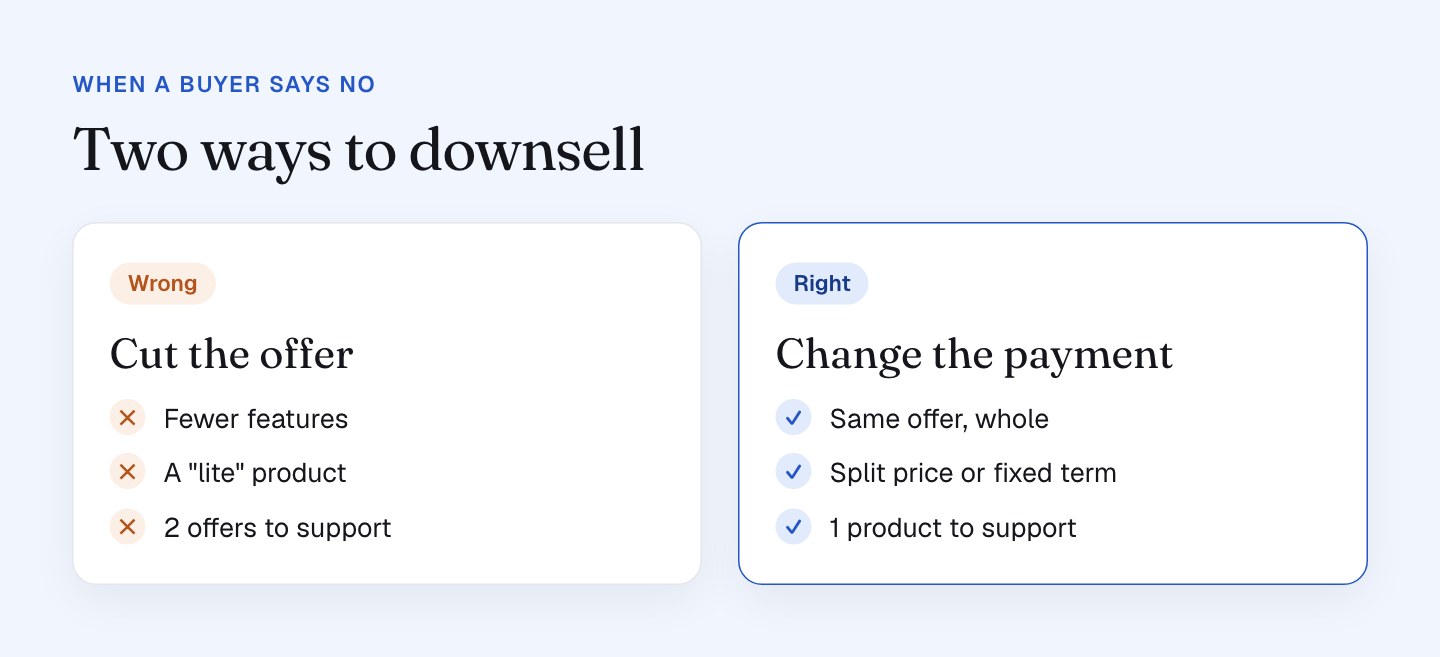
Most downsells do the opposite. They strip features out, call it a "lite" version and hope the buyer settles for less. I think that's a mistake, and I've built my funnel around not making it.
What is a downsell, and why do most of them fail?
A downsell is what you show a buyer at the moment they decline. They looked at your offer, thought about it, and clicked away from it. That is the best time to ask a second question, because they're still paying attention.
Most downsells fail because the second question is the wrong one. The buyer didn't say "I want less." They said something closer to "I want this, but not like this." If you answer with a smaller product, you answer a question nobody asked.
Why should the offer stay the same?
Because the buyer already decided the offer is worth having. A weaker product tells them you weren't confident in the first one, and it makes the original look overpriced. You also create 2 products to support, 2 sets of expectations and 2 groups of customers with different results.
Keeping the offer fixed protects the ladder as well. Everyone who buys gets the same thing, so the people who paid more never feel cheated and the people who paid less still get a real result.
What do my downsells look like?
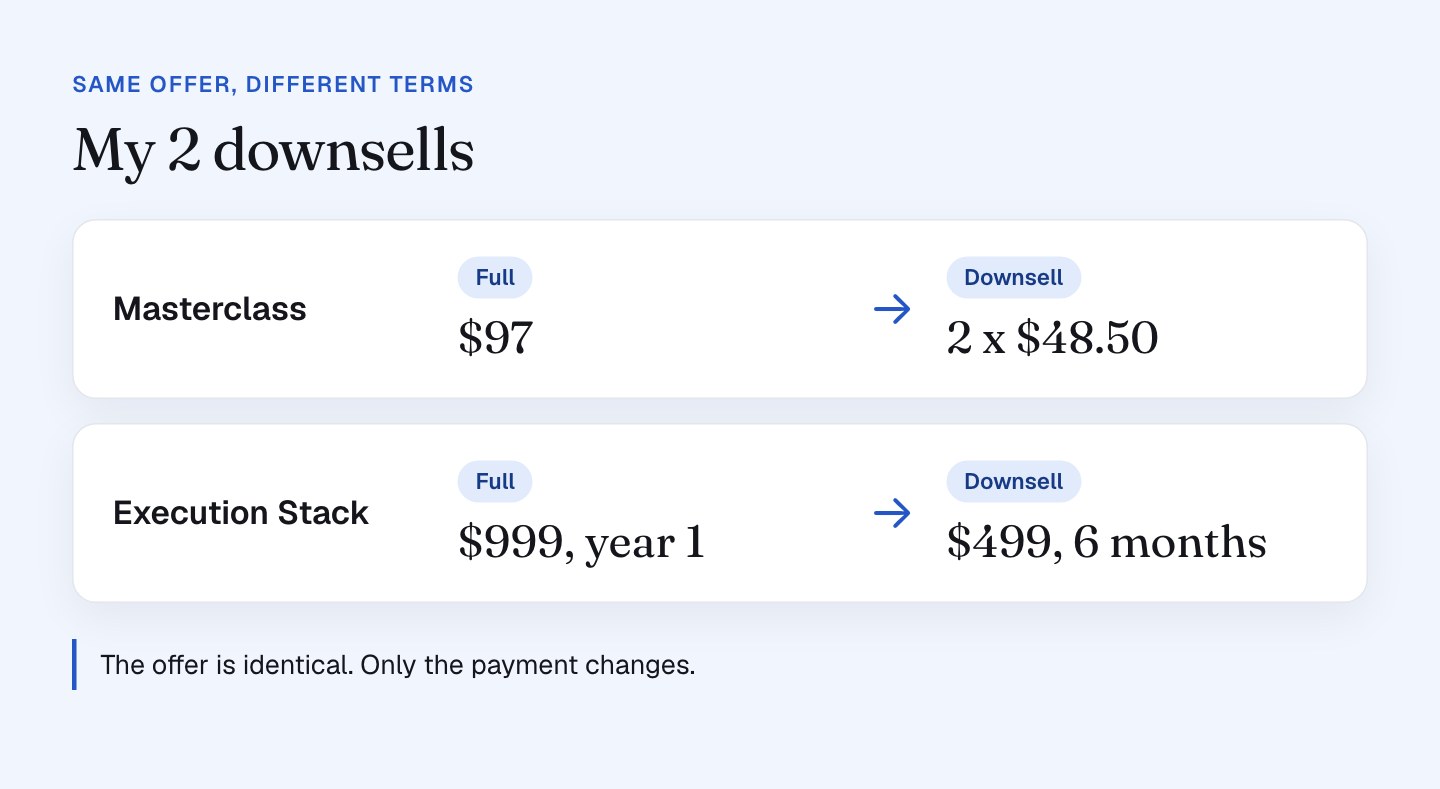
There are 2, and both change payment terms only.
The Masterclass is $97, with a downsell of 2 x $48.50. The buyer gets the whole Masterclass. The only difference is that they pay in 2 parts instead of 1.
The Execution Stack is $999 for year 1, with a downsell of $499 for a fixed 6 months. Same Stack, same tools and same instructions. The term is shorter and the cost is lower up front, which is exactly the objection a buyer at that price point usually has.
These sit on a ladder that starts with a $17 book. I explain why the first rung is paid in why I sell a $17 book instead of giving away a free PDF.
How do you design a downsell that holds up?
Start with the objection. When someone doesn't buy a higher priced offer, the reason is usually 1 of 3: the money isn't there today, the risk feels big, or the timing is off. Payment terms answer the first 2 directly. Splitting the price lowers the bar for today, and a fixed term lowers the commitment.
Then keep 3 things identical: what the buyer receives, what the buyer can do with it, and what support they get. If any of those change, it's a different offer, and it needs its own name and its own page.
Last, make the terms explicit. A fixed 6 months means 6 months, and the page should say so in plain words. Honest terms are what make a downsell feel like a favor and not a trick.
When is a smaller offer actually right?
When it's a separate product with its own job. A $17 book and a $97 Masterclass are different products at different prices, and people buy them on purpose. That is a ladder. A downsell is different: it's the same product, shown a second time with softer terms.
If you keep those 2 ideas separate, your offers stay easy to explain. This is the same thinking as giving every app 1 job: 1 offer, 1 promise, and a clear way to pay for it.
FAQ
What is the difference between a downsell and a discount?
A discount lowers the price of the same offer for the same terms. A downsell changes the terms, such as splitting the payment or shortening the period, so a buyer who liked the offer can afford to say yes.
Should a downsell have fewer features?
No. Fewer features make it a lesser product and teach buyers that your main offer was inflated. Keep the offer whole and change how it's paid for.
Where should a downsell appear?
Right after the buyer declines the main offer, while they're still looking at it. That is the moment they know what they're deciding on, and a clear second option can turn a no into a yes.
If a buyer wants your offer, make it easier to say yes. Don't make the offer smaller.