How I run 4 software products with a small team and AI
You can run several software products with a small team and AI if you do 3 things: keep each product to 1 job, build every app on the same shared foundation, and use AI for production wherever it can do the work. That is how I run Clepher, CommentWard, ReviewComet and the one I'm building now, Robofono.
None of this needs a big company. It needs choices that keep the work small, and a habit of asking whether a person really has to do each task.
What are the 4 products?
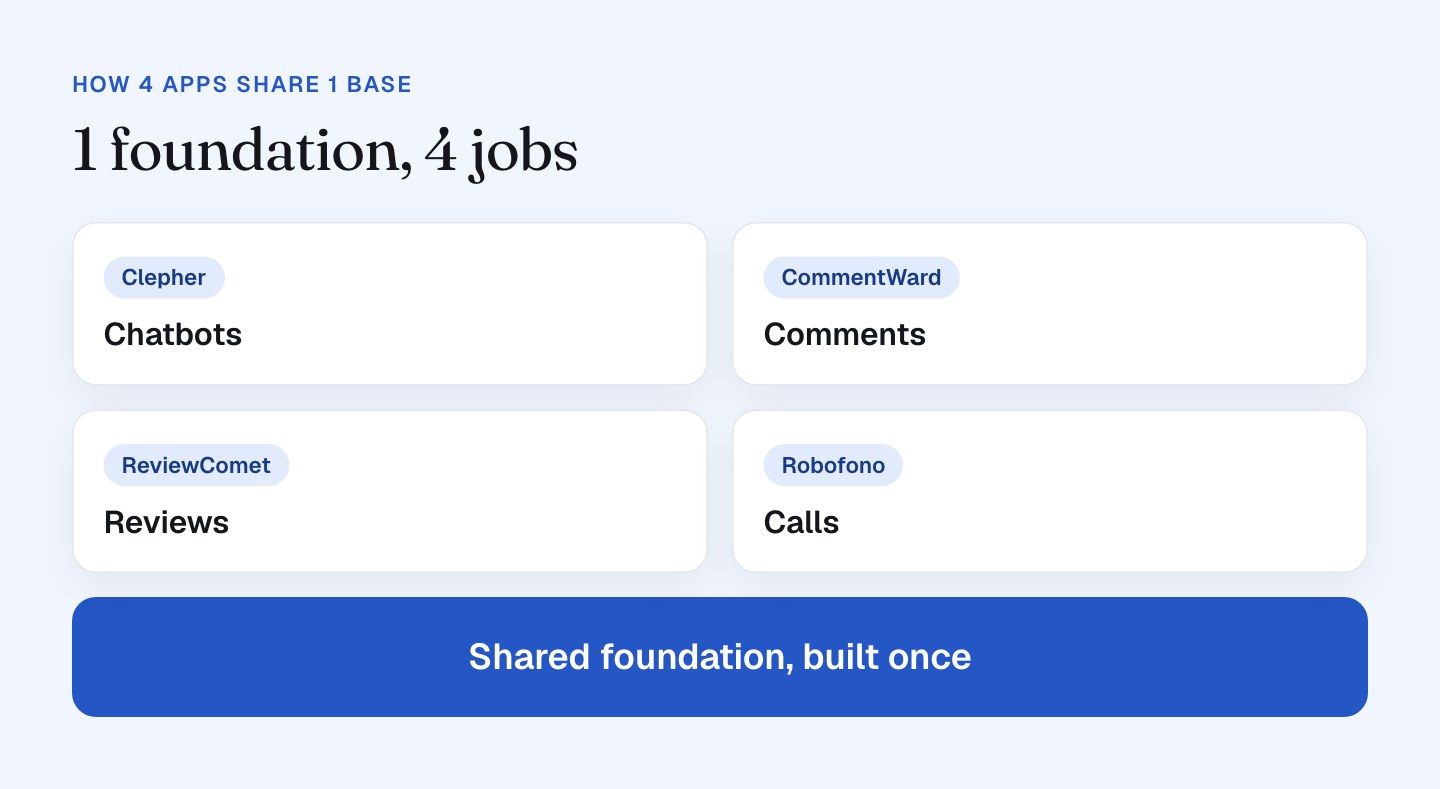
Clepher builds AI chatbots for websites, Messenger, Instagram and WhatsApp. CommentWard puts every comment from Facebook, Instagram, Threads, TikTok and YouTube in 1 inbox and drafts AI replies. ReviewComet asks customers for reviews by email, SMS, WhatsApp or QR, and answers reviews with AI. Robofono is the AI receptionist I'm building that answers every call.
Each does 1 job. That is the first reason the team can stay small, and it's the subject of why every app I build does 1 job.
Why does a shared foundation matter?
Because most of what a software product needs is the same everywhere. All my apps run on the same shared foundation, so each new one starts with the basics already in place. A new product has less to build, less to test and less to support.
That changes how a small team scales. Instead of the work growing with every product, the shared part stays 1 piece of work, and only the unique job of each app is new.
How does AI fit into the work?
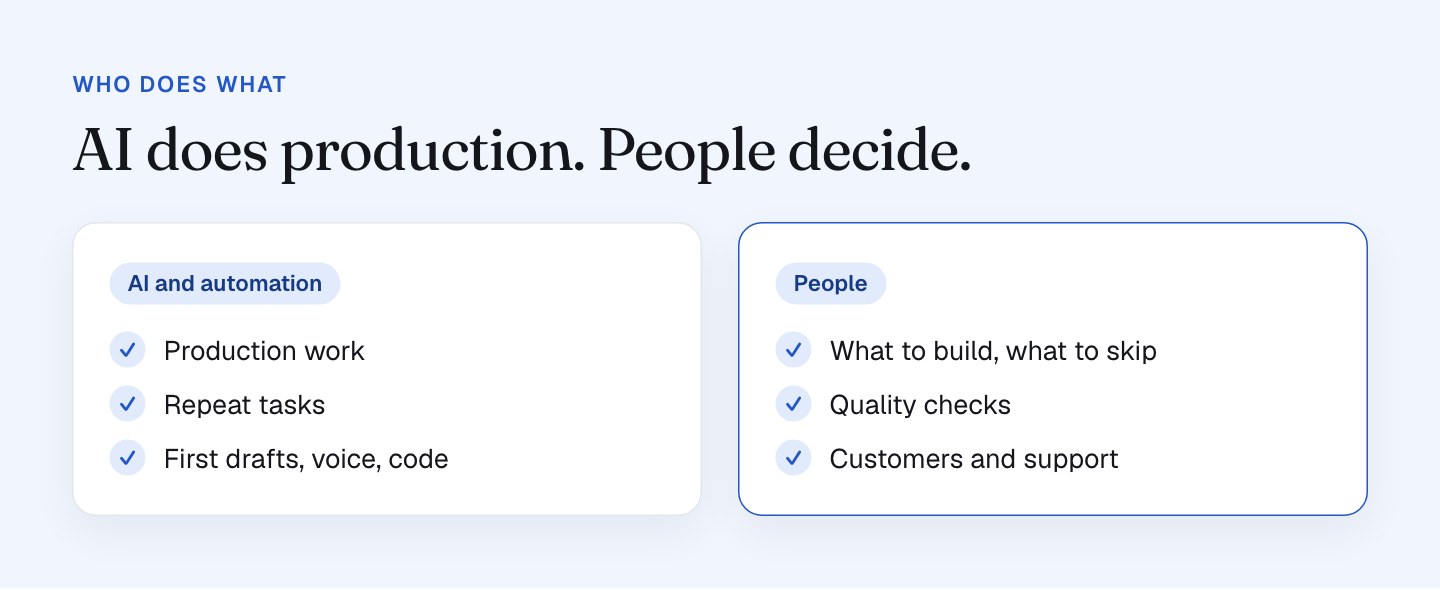
It's the default for production. I build with Claude and Claude Code, I use ElevenLabs for voice, and I run AI agents and automation wherever a task can be handled that way. The question I ask for any task is whether it needs a person's judgment or only a person's hands.
If it only needs hands, I try to automate it or hand it to AI. If it needs judgment, a person does it. That split keeps the team focused on decisions, quality and customers.
What does the team look like?
Small and remote. People work from several countries, and the roles are developers and support. Decisions stay close to the work.
Remote works because the work is written down and the products are narrow. When each app has 1 job, someone can understand it fast, and when the foundation is shared, a developer who learns it once can work across all of them.
What do people still do?
The work that needs taste and judgment. Deciding what a product should do, and what it should never do. Talking to customers and fixing their problems. Reviewing what AI produces before it goes out, because speed without a check just makes mistakes faster.
That's why I keep developers and support on the team. AI makes them faster, but it doesn't replace the person who owns the result. Every output still has an owner, and that owner is a person.
What should you automate first?
Start with the task you repeat most often that doesn't need a decision. Write down the steps, hand them to an AI agent or an automation, and check the output until you trust it. Then move to the next task.
Don't start with the most exciting task. Start with the most boring one, because boring tasks are the ones with clear steps, and clear steps are what AI is good at.
What does this mean for you?
You don't need to copy my setup. You can copy the logic. Make each product do less, share what can be shared, and give AI every task that doesn't need judgment.
It also helps with how you grow. Narrow products are quicker to launch, which fits my habit of shipping first and fixing later. If you want to apply the same thinking to starting an AI agency, the method in The AI Agency Method walks through it step by step.
FAQ
Can a small team really run multiple software products?
Yes, if the products are narrow and share a foundation. The team's work then grows with the number of jobs, not with the number of features inside 1 giant product.
Which AI tools do you use?
I build with Claude and Claude Code, and I use ElevenLabs for voice. I also use AI agents and automation across the business wherever they can handle a task.
Does AI replace the team?
No. AI does production work, and people make the decisions that need judgment, such as what to build, what to say no to and how to treat customers.
Small teams don't win by working harder. They win by having less to do.